

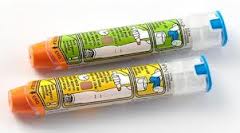
Do you stock spare adrenaline auto injectors in school? An update in recent legislation gives more clarity on how a spare auto injector such as an Epi Pen (an AAI) should and could be used to treat anaphylaxis, a severe allergic reaction in school. These are questions we often get asked by schools as to who can adminster adrenaline, does a child need a prescription to receive it and should the school stock a spare in the first place.
Yes.
The MHRA now states that spares are no longer used solely for children with a known allergy/prescription. They can be used on any child suspected of having and anaphylactic reaction.
Under Regulation 238, the MHRA permits a school’s adrenaline auto-injector(s) to be used for the purpose of saving a life, for a pupil or other person not known by the school to be at risk of anaphylaxis (and thus does not have medical authorisation/consent in place for the spare device). This might be, for example, a child presenting for the first time with anaphylaxis due to an unrecognised allergy.
“There is provision in the legislation (under Regulation 238) for an emergency medicine listed in Schedule 19 (which includes adrenaline in a formulation and presentation consistent with that in AAIs) to be administered to anyone for the purpose of saving a life. Therefore, a school’s back-up AAI, which has not been supplied against a prescription for a named individual, can in principle be used in the event of an emergency to save the life of an individual who develops anaphylaxis unexpectedly. The provision should be reserved for exceptional circumstances only, that could not have been foreseen.”
Yes.
As a result of the Human Medicines (Amendment) Regulations 2017 schools have been permitted to buy AAI devices without a prescription, for emergency use in children who are at risk of anaphylaxis but their own device is not available or not working (e.g. because it is broken, or out-of-date).
Yes.
Regulation 214(2) of the Human Medicines Regulations 2012 specifies that prescription only medicines should not be administered by anyone (except from him/herself) unless they are an appropriate practitioner or acting in accordance with the directions of an appropriate practitioner (doctor, nurse, etc.).
However – Regulation 238 of the 2012 Regulations provides a legal exemption to this, stating: “Regulation 214(2) does not apply to the administration of a prescription only medicine specified in Schedule 19 where this is for the purpose of saving life in an emergency.”
Yes.
Auto-injectors provide a pre-defined dose of adrenaline (a naturally occurring hormone); therefore, overdosing would be extremely difficult, if not, impossible. Therefore, based on the current evidence, the benefit of using appropriate doses of intramuscular adrenaline far exceeds the risk in an allergic emergency. (You should always dial 999 in an anaphylaxis emergency)
Adrenaline is a Prescription Only Medication (POM), as with all POMs they must have a document called a Summary of Product Characteristics (SmPCs) which provides a thorough overview of the drug e.g. Dose, side- effects, contraindications and other safety data. All adrenaline auto-injectors currently available in the UK have one statement that is consistent in all their SmPCs: “There are no known absolute contraindications to the use of [adrenaline] auto injector during an allergic emergency.” There are very few drugs out there that have no contraindications (A contraindication is a specific situation in which a drug, procedure, or surgery should not be used because it may be harmful to the person).
Yes.
The Department of Health has stated that it is reasonable for ALL staff to:
– Get trained to recognise the signs and symptoms of an allergic reaction
– Understand the rapidity with which anaphylaxis can progress to a life-threatening reaction, and that anaphylaxis may occur with or without prior mild (e.g. skin) symptoms;
– Appreciate the need to [administer adrenaline (using an AAI) without delay as soon as anaphylaxis occurs, before the patient might reach a state of collapse (after which it may be too late for the adrenaline to be effective);
– Know the anaphylaxis policy;
– Be aware of how to check if a pupil is on the register;
– Know how to access the AAI;
– Have awareness of which staff members have received training to administer AAIs, and how to access their help.
There are a number of possible signs of anaphylaxis. Any one of the following signs/symptoms is enough to warrant immediate use of an adrenaline auto-injector:

Do not delay in administering an adrenaline auto-injector if you have any of the above signs or symptoms, even if you also have signs that you would normally associate with a milder reaction (such as an itchy throat or swelling of your lips).