

Young first aiders have a wonderful sense of responsibility and achievement, an awareness of the world around them and let’s face it, they pick up things so much quicker than us adults and have the time and energy to learn.
Whether there’s a collision on the playing field, a friend having an asthma attack, or a parent collapsing suddenly, young children from as little as four years old are very capable of reacting quickly to save a life and get help. BUT, only if they have the confidence and knowledge to do so.
And it isn’t just about helping others, little ones can learn how to stay safe themselves. How often do parents shout “Get down from that chair!” when their children are teetering, arms extended to reach the sweet tin. You’ll be surprised at how much they listen to a first aid trainer when they don’t listen to their parents!
As adults we are more likely to know when someone is choking, struggling to breath or unconscious. Even if we’ve never witnessed it ourselves, we’ve certainly watched TV dramas. But for children it’s going to be a complete surprise and something they’ve never ever seen before. So knowing how to stay calm, find out if a person is ok and how to call 999 is essential. And that’s where DRAB comes in. Tattooing these simple emergency action steps onto the big minds of little one’s could save someone’s life!
As parents we can help by leaving an Emergency Contacts Sheet visible in the house. The child can see what number they need to call, know how to dial 999 if mummy is poorly, mummy and daddy’s phone number and their own home address to tell the emergency services.
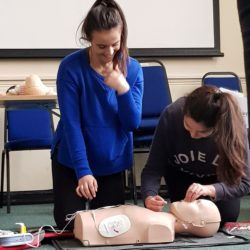
They can be taught what vehicles are used in which type of emergency too – fire engine, ambulance and police car. And from nine years up, as children become more independent, they can learn how to give CPR chest compressions if a person is not breathing, treat minor burns, bleeds and even use an epipen if their friend has an allergic reaction or an inhaler if a parent has an asthma attack.
If a child is out and about and has an accident themselves, memorising their own address and telephone number is sure way to get help faster. Their parent may be able to give lifesaving information on their child’s medical condition such as epilepsy and allergies. And it goes without saying that the child should be aware of their own medical conditions themselves.
So give our little ones the chance to become the next generation of lifesavers by coming on a Child Matters first aid training day and learning all this and more.
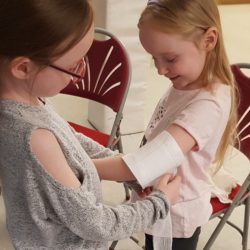
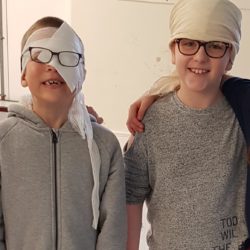
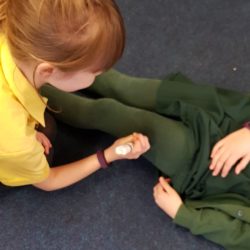
Flat Stan manikins and Flat Stan workshops are perfect for EYFS and Key Stages 1-4 and works well with the school curriculum. The kids take away an achievement pack, first aid book, certificate and sticker. But most importantly they take away a skill for life. They’ll learn:-
How to stay safe and avoid accidents & how to help save lives:
For older children, on our Junior First Aid training they can learn how to give CPR compressions, managing a burn, treating a casualty with a
Here’s what Georgia from Year 6 had to say when she attended a basic first aid course in June:-
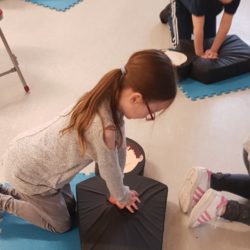
“Blake Class learnt so much on Friday. Thanks to Claire, we all really enjoyed it! We learnt how to do CPR, how to deal with burns, bleeds and choking, and how to use a defibrillator.
In order to do CPR, you have to interlock your hands and press down on the chest with the palm of your hand. Next, press down twice per second and wait for the ambulance/paramedics to arrive so they can handle the situation professionally.
My favourite part was using the Epi-pens, as we each got a training one (with no needle) and jabbed it into our thighs until it clicked. It showed us what to do in an emergency when someone is having a serious allergic reaction.
We also learnt what numbers to call in an emergency.
Courses for young first aiders can be run in the school timetable, after school, in wrap around care, holiday clubs or at a private venue as a social event. We can tailor to your timings, number of children and schedule. To discuss how our training can benefit your setting or to book a course for the kids in your care, please CONTACT US today.