


With the weather changing, kids finally back at nursery and school, more bugs being shared around, it’s not surprising that lots of our little ones have high temperatures. And it’s not always a sign of COVID 19 as many infections, including common viruses, can cause a rise in temperature.
As young children can’t communicate how they’re feeling, testing their temperature with a thermometer is often the only way to catch early symptoms of most illnesses so it’s important to know when your child has a fever and be able to spot when it’s too high.
Digital thermometers are best
Much more reliable than the old style thermometers (often filled with mercury too so should be thrown away!). They’re either placed in your child’s ear, orally or use no-contact forehead readings and designed to make the process of taking your child’s temperature less invasive. The NHS also doesn’t advise using strip-type forehead thermometers for gaining an accurate reading as they show the temperature of the skin rather than the body.

Spot the first signs of a temperature
If your little one seems a little under the weather, it’s worth checking for a temperature. Typical signs to look out for include:
More serious signs of illness (such as sepsis) that might accompany a temperature include:
How to take your baby’s temperature:-
Digital ear thermometers
Ear thermometers (also known as tympanic thermometers) are designed so that they disturb babies as little as possible, allowing you to take your baby’s temperature even when asleep. They take a reading after a second or two, using infrared to measure the heat generated inside the ear. The reading may not be accurate if the thermometer isn’t correctly placed in the ear or there is too much earwax. Also wait 15 minutes before measuring ear temperature if your baby has been outside on a cold day. These types of digital thermometer shouldn’t be used with babies under 3 months as their ear canals are too small.
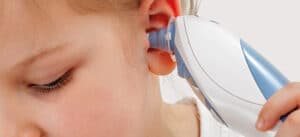
Good ear thermometers need to be a simple one touch operation so you don’t have to reach for the instruction manual. Look for models with backlights so you can read the results without turning lights on. Some in-ear thermometers require you to buy disposable probe covers, which is more hygienic.
No contact thermometers
Even newer to the scene than ear thermometers are infrared no-contact thermometers. These are usually simply pointed at a child’s forehead (usually at a distance of around 5cm, but this can vary from brand to brand) and give a reading very quickly. They’re obviously appealing to parents as you may not even have to disturb your sleeping child to get a measurement.

A great infrared no-contact thermometer should be easy to use and quick to give a measurement. A back light for seeing readings in the dark and a traffic-light system to indicate a fever are popular features. Some also have the ability to measure room and surface (ie liquid) temperatures. Another advantage is that they are hygienic and don’t require probe covers like some ear thermometers do, although you must make sure you keep the infrared sensor clean. When using an infrared forehead thermometer you’ll need to ensure that you push hair back from the face, and you may need to dab away any perspiration.
Oral or Underarm digital themometers
For oral use, these digital thermometers can be quickly placed under the tongue to give accurate readings and are suitable for under 5’s. Chose one with a flexible tip. Generally underarm is a good back up but sometimes hard to keep in place if your child moves around. Make sure you hold your baby in a firm grip if you choose to do it this way.
What should you do if your baby or child has a temperature?
You can give your child Calpol for a temperature but if symptoms are not relieved afterwards take them to the doctor, especially if they are still:-
If you need to speak to someone outside of normal surgery hours, call your GP’s out-of-hours service or NHS 111. If your child is running a temperature, but generally feeling OK and not in distress, continue to treat with rest and fluids. If the fever continues for more than five days, you should contact your GP for your child to be assessed again. Never use a damp sponge or put your child in a cold bath, it can trick their core temperature and increase it. Also avoid wrapping them up.
What is a safe temperature range for a baby or child?
While there’s a fair bit of variation with kids, the normal range for children is 35.8°C to 38°C, with it usually falling around 36.4°C. However, it’s worth taking your baby’s temperature when they’re well a few times so you get an idea of what’s normal for them. If your baby is under three months and has a temperature of 38°C, that’s considered a fever. In this case, take your baby to a doctor, regardless of whether he or she has any other symptoms of illness. Any child aged three to six months with a temperature of 39°C or higher and is not relieved with Calpol, or six months and over and with a temperature of 40°C, should be assessed by a clinician.

Febrile convulsions
These are a type of fit (seizure) that can happen when a child has a high temperature, although it’s not thought that the fever itself causes the convulsions. While they can be scary for parents to watch, in most cases they are not harmful to your child. They usually last about five minutes. Your child will become stiff, their legs and arms may twitch, and they may lose consciousness and wet or soil themselves. Your child may be sleepy after the seizure. If your child has a febrile convulsion, you should stay with them, and try to put them in the recovery position. Make a note of how long the seizure lasts. If this is the first fit they’ve had, or it lasts longer than five minutes, call emergency services on 999. Calpol or other infant pain relief will have no effect on preventing febrile convulsions.
Smart digital thermometers
Some thermometers can now be connected up to apps on your smartphone or tablet so that you can store a larger database of past readings or connect up to health advice.


