


We get lots of questions about first aid training, mostly from childminders asking how they can be compliant with first aid and adhering to the requirements of registering on the OFSTED register.
So here to help ensure you’re meeting standards, and dispel some common myths, are a few of the most frequently asked questions and answers.
1 ) I’m not sure what first aid course I’m supposed to do? Is it 6 hours or 12 hours? Or more?
PAEDIATRIC 12 HOUR INFANT / CHILD FIRST AID LEVEL 3 (VTQ) – (PFA) CPD certified 12.0 hours
The criteria to be a childminder, nursery and preschool staff or Early Years teacher, clubs and anyone wanting a more in-depth Paediatric first aid course need to complete a 12 Hour Paediatric First Aid Course to comply with the requirements of registering with EYFS, and SureStart.
Occupations That Use This Course, Childminders, EYFS Teachers, Nursery workers, School Clubs, Extra Curricular clubs with early years children, School nurse
Our 12-hour course can be delivered as a blended course, a video-based online course that is completed before attending a full day in the classroom with an instructor to complete the practical part of the course.
Emergency Paediatric First Aid (EPFA) level 3 (1 Day 6 Hours) CPD Certified – 6.0 hours
The minimum requirements for Teachers/Teaching Assistants (KS1 and above), Nannies,, AuPairs Carers and Voluntary Workers state that a minimum 1 Day 6-hour Emergency Paediatric First Aid Level 3 course is required. Designed to cover all the skills required to care for children (5-18yrs), staff and parents, this course must be at least 6 contact hours and run over a minimum of 1 day or 2 shorter sessions and the certificate is valid for 3 years. The one-day course meets the criteria of the reviewed guidelines (March 2017) and meets the needs of the Voluntary part of the Ofsted Childcare Register.
2) How many First Aiders do I need in my setting?
Many childcare settings now choose to train all staff working with children, including catering staff, admin staff and part time supervisors.
Specifically, the EYFS requires that at least one person who has a current paediatric first aid (PFA 12 Hour) certificate should be on the premises and available at all times when children are present and should accompany children on outings.
All staff who obtained a level 2 or level 3 qualification on or after 30 June 2016 must also have either a full PFA or an emergency PFA certificate within 3 months of starting work in order to be included in the required staff to child ratios at level 2 or level 3 in an early years setting.
Childminders, and any assistant who might be in sole charge of the children for any period, should hold a current 12 Hour paediatric first aid certificate.
Paediatric first aid training must be renewed every 3 years and should be relevant for workers caring for young children and where relevant, babies. Employers should take into account, via their first aid needs assessment, the number of children, staff and layout of premises to ensure that a paediatric first aider is able to respond to emergencies quickly.
3) Can I do my training 100% online?
In short the answer is NO. But for some courses there are options to enable you to complete part online and part in the classroom. This can save you time and money. However the online element of Paediatric first aid courses is a replacement for 1 classroom day so will be 6 hours of eLearning, not a quicker short cut!
The elements that make up the Emergency Paediatric First Aid course need to be delivered 100% in a classroom setting. 6 Hours learning with a trainer to ensure there is plenty of opportunity to practice and demonstrate the skills.
Part 1 of the Blended 12 hour PFA course is 6 hours of online training that make up the full 12 Hours required for Paediatric First Aid course . The online element is carried out through video eLearning with an appropriate means for checking understanding and assessing the skill of the learner. The skills that can be included in the online aspect of the course are more theoretical, and although hands on practice is essential in all first aid, it is believed that these types of skills can be effectively taught and assessed online, and where appropriate followed up within the face-to-face aspect of the training as needed.
Find out more about the benefits of blended learning in this video
4) My first aid runs out next week and I can’t get on a course for 3 months. Is that okay if I show OFSTED that I am prebooked on to a course?
No. You will no longer be deemed competent to act as a paediatric first aider during those 3 months you are not certified. Your training must be up to date (within the last 3 years). EVEN if you are taking a break or have ’no children on roll’.
The EYFS says you must either display your certificate or have it in a file accessible by parents.
5 ) I did a first aid course recently in another job but it wasn’t a specific paediatric first aid course. Do I need to do another course now I’m a childminder or childcare professional?
Yes, you need to do a ‘paediatric’ first aid course that meets the requirements of EYFS or Ofsted syllabus, specific to your new role that covers the lifesaving skills needed to work with babies and children. Paediatric First Aid training was developed to meet the needs of the Early Years Foundation Stage Statutory framework (EYFS) and includes training in a host of injuries and illnesses that child carers may be faced with when caring for young children.

5 ) My first aid runs out in 6 months. Do you think I should start looking at booking one now for then?
Yes definitely. Book ahead before your certificate is due to expire. OFSTED states that childcare professionals need to undertake a requalification course before their three-year certificate expires, to obtain another three-year certification. If your certificate expires and is not renewed, you are no longer deemed competent to act as a paediatric first aider. Check out our Child Matters classes taking bookings all year round at various public venues.
6 ) How much would you expect to pay for first aid? Who would you recommend I book with?
The costs of first aid courses vary greatly dependent on the length or course, whether it is all classroom or blended learning and who the provider is. Expect to pay between £70-£180 and these prices can be reduced if booking with a group or in your own setting.
Many companies like us at Child Matters are independent training providers offering and specialising in First Aid Training Courses. Those independent companies need to be approved centres, working under an awarding body ensuring they meet standard requirements. It is the student’s responsibility to ensure that the training is quality assured, monitored and delivered in accordance with regulatory and industry standards. The courses smaller companies deliver are mapped, designed, and conformed to meet the UK Resuscitation Council Guidelines who oversee first aid requirements in the UK and who Red Cross and St Johns would refer to for first aid compliance.
8 ) I have a knee/hip injury, I have mobility issues, I can’t kneel for long periods, can I still attend a course.
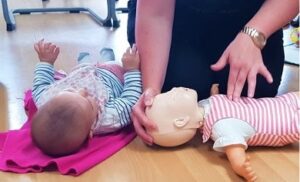
First Aid training is practical and active. We would normally expect participants to be capable of kneeling, bending, lying down, performing simulated CPR and able to take a full and active part by acting as casualties for both the trainer/s and each other. If you feel uncomfortable or have any concerns whatsoever, please do not hesitate to inform our experienced trainer/s who may well have a strategy for helping you throughout the course. The trainer is always sensitive to the needs of each person. It doesn’t matter if you are slow getting up and down off the floor and where necessary we can adapt training to ensure you can demonstrate the required skills.
Please ensure you wear comfortable clothing suitable for carrying out practical exercises.
9) Will my paediatric training cover me for staff and parents as well as children?
Unfortunately, not. In addition to the EYFS paediatric first aid requirements you will also need to meet the needs of the Health and Safety (first aid) regulations 1981 (HSFAR). Unlike the EYFS statutory framework, these regulations put the responsibility on the employer by asking them to assess the first aid needs of their individual workplace and determine the level of first aid personnel and equipment is required to ensure the safety of staff. Although this sounds daunting, it really is very simple.
10) Do Ofsted set the first aid training?
If you asked any training provider whether their first aid course is Ofsted registered, then the answer should always be no. If a course is advertised as Ofsted registered, then please question the training provider. Ofsted publish the criteria for an appropriate first aid certificate, but they do not register first aid training.
11) What should I do if a child needed to go to hospital?
You should have a policy that is shared with parents explaining what would happen in an emergency and parents are not contactable. If they are going to hospital in an ambulance and you have children in the setting, as a general rule, paramedics advise that you send the child with the paramedics and make every effort to contact parents.
12) What can I do if a child arrives with medication?
Check that the medication comes in the original box, named for the child (if prescribed) and with instructions. Complete a medication administration record form – ask parents to sign to confirm what it is for, when the medication should be administered and where it should be stored. Sign when the child has been given the medication and ask parents to sign to confirm the medication has been given.
13) How do you record accidents?
An accident record book or electronic accident reporting system is mandatory. Hardcopy records books with counterfoil pages can help with sharing the information with parents.
14) How many first aid kits should I have?
You should be able to get to an injured child within seconds. If your environment has more than one floor, or several areas in a building or outside then you must have multiple kits to be within easy reach, wherever you are in the setting. A first aid kit should always be taken on trips and journeys. Emergency medication should be carried with you but separately from inside the first aid kit.

15) Can I apply a plaster to a child?
Yes. But note that some children have allergies to the adhesive used on fabric plasters (i.e. plasters that contain latex), which is why we recommend you use Steroplast’s “Sterostrip” washproof plasters in our Child Matters First Aid Kits.
With so much conflicting advice on what can and can’t be used on children, Steroplast have consulted with Millie’s Trust, the editor of a All Steroplast’s washproof hypo-allergenic plasters are perfect for a child’s sensitive skin. first aid manual and OFSTED themselves to give you a 100% guarantee that if it’s got Steroplast’s name on it, it is approved and safe for use on children. The contents are based on a combination of advice from The National Childminding Association, the Health & Safety Executive, and the Pre-School Learning Alliance.
For all your paediatric first aid needs take a look at our Child Matters public courses running in Oxfordshire, Berkshire, Buckinghamshire, Hertfordshire, Bedfordshire and more…
Or Contact Us for inhouse group training at your own setting.


