


Adults, children, and infants all have different needs when it comes to CPR so it can be very daunting to know what to do first if you are faced with an unconscious victim. Do you phone for help or start CPR straight away and are the techniques the same for both?

It’s a fact that children have higher survival rates after receiving immediate CPR than adults. This is mostly because they are so resilient, but also because they are more likely to need CPR because of a blocked airway rather than a cardiac arrest. Because of this, it is especially imperative that children receive lifesaving CPR immediately.
While adults can suffer from choking, blocked airways, drowning incidents, and other problems, most adults need CPR when they experience cardiac arrest.
Because of this, the order and emphasis in which you carry out CPR would be slightly different depending if they are an adult or a child.
With an adult you would mostly CALL FIRST and a child you would CARE FIRST.
Call 999. When performing CPR on an adult, you should call for help immediately before beginning if you are the only person present. Unless you believe the person is unconscious because of a blocked airway; in which case you should call 999 after providing CPR for a minute. If there are others nearby, someone else should call 999 while you begin.
Note that compressions most likely won’t restart a person’s heart (only an electric shock will do that) BUT it will keep the heart pumping and provide oxygen to the brain and other organs until medical help arrives.” “It is quite normal for an adult to vomit when they are unconscious. If you don’t know the victim and are concerned about giving rescue breaths, the most important thing is to give compressions.”


Watch video on how to use a Defibrillator.
Generally, children’s bones are more flexible than adults’; a young child’s bones are more likely to bend where an adult’s would break. Their tongues are larger in proportion to their mouths as well, and their airways are narrower. Because of these characteristics and the habit young children have of putting foreign objects in their mouths, children are more likely than adults to need CPR as a result of a blocked airway.
Most of the techniques used for children aged one to eight years old are the same as those recommended for adults. Here’s an overview of the places where there are differences.
Most experts will tell you to start CPR immediately on a child if you are the only person present and you have to make a choice between beginning CPR and calling emergency response. This is because children are generally more resilient than adults, and their chances of survival if they receive immediate CPR are much higher – approximately 70%. If alone, you should call 999 after providing CPR to a child after five compression and breath cycles, which should last about two minutes.”
Of course, if there are other people around, someone else should call 999 immediately as you perform CPR.
Children’s airways are more fragile than adults’ so be careful when providing rescue breaths not to tilt the head back too far. This can block the airway further, especially for smaller children. Breathe more gently with a child than you would with an adult.
Provide compressions. Depending on the size of the child, you can use one or two hands to provide compressions. Because children have smaller chests than adults, the depth of compressions should be only one and a half inches. The compression and breath rate should be the same for children as for adults – 30 compressions to two breaths but starting with those all important 5 rescue breaths.

If you have access to an AED, you should use it after five cycles or about two minutes of CPR. Use the paediatric pads if they are available.
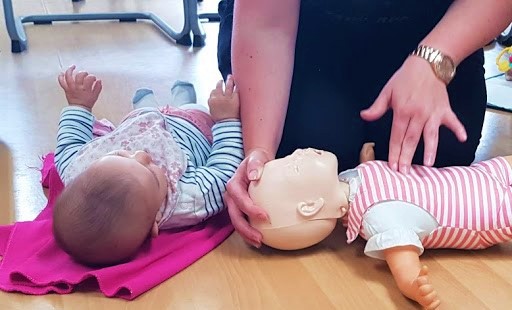
Infants are even more fragile than children as their bones are more delicate. So before you begin CPR on baby to check if they are responding, shaking is not advised. Instead, gently stroke the baby, or tap the soles of the feet, and watch for movement or another response.
As with small children, infants have a higher survival rate than adults when receiving immediate CPR.
Infants have very fragile airways that become blocked easily. Tilting the head back too far can make the problem worse. The correct position for infants is called the “sniffer’s position” which entails tilting the head back just enough to make the baby appear to be sniffing the air.

When providing rescue breaths, be very gentle. Use your cheeks rather than the full strength of your lungs to expel the air into the baby’s mouth. Because babies’ faces are so small, you can cover their entire mouth and nose rather than just their mouth when providing rescue breaths.
Provide compressions. Because they are so small, babies only require two fingers in the center of the chest during chest compressions. Compressions for infants should only be an inch to an inch and a half deep. Frequency should be 30 compressions to two rescue breaths.


