

When teaching first aid we often talk about watching skin for signs of deterioration – looking out for a change in pallor, often pinky complexions turn pale white or grey particularly in cases of shock. But how do you recognise this deterioration in dark skin? Any other common childhood illnesses for that matter?
Black skin matters have published this great information on identifying different skin conditions and on a child with a darker skin tone.
Pallor refers to the pale appearance of skin due to reduced oxyhaemoglobin levels that may occur in anaemia or shock. In darker skin pallor may be identified by asking the child to turn their palms to face the ceiling and looking for reduced darkness in the palmar creases. It’s useful to compare the child’s palms with your own or that of a family member.
Pallor can be also be identified by pulling down the child’s lower eyelid. The palpebral conjunctiva is usually a health pink due to the blood supply of the vascular bed but in anaemia it will appear a pale pink or white (regardless of skin colour).
Cyanosis refers to a blue or grey discolouration of the skin and mucous membranes due to high levels of deoxygenated haemoglobin caused by hypoxaemia (low arterial oxygen). Note that this is distinct from hypoxia which refers to inadequate oxygenation of tissues.
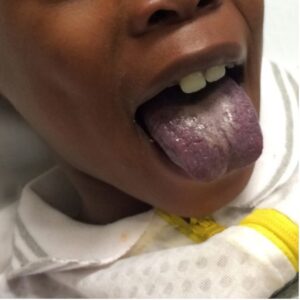
When the oxygen level has dropped only a small amount, cyanosis may be hard to detect. In dark-skinned people, cyanosis may be easier to see in the mucous membranes (lips, gums, around the eyes) and nails. Normoxaemia refers to having a normal concentration of arterial oxygen. Post-oxygen therapy the patient’s tongue and lips should have a healthy pink colour due to correction of arterial oxygen and subsequent tissue oxygenation. The facial skin should appear it’s usual colour, not the “ashen” (pale grey/blue) tone associated with cyanosis.
Erythema refers to the red appearance of skin associated with inflammation and infection. It is harder to detect in dark-skinned children. With light skin, irritation may cause redness. But in a darker skin tone, it may cause increased pigmentation or reduced pigmentation, with no redness visible. Sometimes, dark skin takes on a dark bluish-purple tint at the site.
A ringworm (fungal) infection affecting the scalp can live on the epidermis and hair and lead to patching, scarring of the skin and secondary bacterial infections. Infection of the skin can cause a slightly red hue and itching and the skin will appear dry and flaky. It is most common in children aged 3 to 9 and is more prevalent in patients from African-Caribbean backgrounds.

Jaundice refers to yellow discolouration of the skin and soft tissues due to hyperbilirubinaemia causing bile pigment deposition.

In darker skin, jaundice might only produce subtle yellow discolouration. The child themselves or their parents might have noticed a change. It is useful to compare the patient’s skin to their family members or previous pictures of themselves. Eye signs are more obvious; icterus of the conjunctiva! membrane which overlies the sclera will make the ‘white of the eyes’ appear yellow.
Meningococcal disease refers to meningitis and meningococcal septicaemia caused by the Neisseria meningitidis bacteria.


Look for the “pin-prick” rash in any unwell child. The child may also have a fever, breathing difficulties, difficulty rousing and high-pitched cry amongst other symptoms. The petechiae (small red/purple/brown purpura) do not disappear when pressure is applied to the skin in 50-75% of cases (non-blanching). They are caused by bleeding into the skin. Maculopapular rashes can also appear with these patches becoming larger. Any part of the body may be affected but it most commonly affects the trunk and limbs. Particular attention should be paid to dark skin as lesions might be subtle. Ensure adequate lighting and ask the child’s parents if they have noticed any new marks. Lesions should be documented accurately. Do not delay treatment, meningococcal disease is a medical emergency.
Chickenpox is caused by the Varicella Zoster Virus. It commonly occurs in childhood and is highly contagious characterised with widespread, itchy, papular rash and fever.

The small red papules may appear more subtle in dark skin but will soon develop into fluid filled blisters (vesicles). These may spread all over the body but don’t scratch them as this could increase the risk of secondary bacterial infection.
Eczema Herpeticum is a serious viral infection associated with HSV1 or 2 (Herpes Simplex Virus). Those with severe eczema are at higher risk of developing it.

It often presents with eruptions of multiple painful, itchy vesicles affecting the neck and face but other sites can be affected. They may crust and form erosions and scarring. These are depigmented (more pale than surround skin) and appear a light pinkish-brown colour getting slightly darker over time. It is not uncommon for deep scratching and picking to lead to secondary bacterial infection. In darker skin tones atopic eczema may leave grey/silver patches and plaques.
Measles is a viral condition which causes fever, coryza and a maculopapular rash with small, white “Koplik spots” may be seen on the oral mucosa. A blotchy rash typically appears a few days after the initial symptoms starting in the head and neck and spreads to the trunk and rest of the body. Palms and soles are usually spared. The rash is non-itchy, it consists of macules (flat area of altered colour) and papules (raised areas).

Molluscum contagiosum is a common viral skin infection which presents with papules. It is most common in children, particularly in warm and overcrowded environments and more common in skin with atopic eczema and more severe in those with immunosuppression (e.g. HIV).

Molluscum presents as clusters of small round papules. These are solid, raised lesions (less than 5mm in diameter). They may be skin colour or take on a more pinkish tone. It is often associated with dermatitis. Similar to other conditions, excoriation may increase the risk of secondary bacterial infection.
If you want to learn more about common childhood illnesses, skin conditions and how to recognise and treat symptoms, Child Matters run Family First Aid classes for you and a group of parents or friends. Just Contact Us to arrange a class in the comfort of your own home or find out when our next public courses run .


